


Hexascapes - Block Puzzle
EASY PLAY GAME TECHNOLOGY LIMITED
I started Hexascapes - Block Puzzle expecting a simple way to fill a few spare minutes, and that is exactly where it makes the most sense. This is a casual puzzle game from EASY PLAY GAME TECHNOLOGY LIMITED, built around arranging and clearing hexagonal blocks rather than asking me to learn a complicated rule set. My first move was easy to understand: choose a piece, place it on the board, and watch the available space change. That immediate connection between action and result is the game’s strongest opening.
What kept me playing was not a dramatic story or a large collection of characters. It was the small satisfaction of making a placement that looked awkward at first, then finding that it opened a useful pocket for the next piece. The game turns a short sequence of decisions into a quiet routine: place, clear, reassess, and decide whether one more move might improve the board. If you enjoy relaxed block puzzles and want something approachable, this is an easy game to understand within moments.
How the first move becomes a repeatable puzzle loop
The first action in Hexascapes is deliberately low-friction. I do not need to spend time learning a long tutorial before testing the board. The hexagonal format gives the familiar block-puzzle idea a slightly different shape, so the challenge is not only about filling obvious straight spaces. I have to look at the available angles and think about how a piece will affect the spaces around it.
That distinction matters. In a conventional square-grid block game, I often rely on familiar patterns almost automatically. Hexagonal pieces make me pause for an extra second. A placement that seems to fit can still leave an awkward gap, while a less obvious position may create room for several useful pieces later. The game therefore feels accessible without being completely mindless.
I found the best way to begin a round was to resist placing the first piece in the most visually convenient location. Instead, I looked at the full shape and considered which areas would be hardest to fill afterward. This is a practical habit, not a complicated strategy guide: protect flexible spaces, avoid sealing off narrow pockets too early, and use larger or unusual shapes when the board gives them a natural home.
Related News






The important decision happens before the placement, not after it. Once a piece is on the board, the feedback is immediate enough to show whether the choice helped. That makes each move feel understandable, even when it turns out to be a mistake. I never felt that the game was asking me to guess an invisible rule; the board itself provided the information needed for the next decision.
The hexagonal layout also changes how I scan the screen. I was not simply searching for a single horizontal or vertical line. I was checking clusters, edges, and the way neighboring cells connected. That extra visual step gives the game its own identity within the casual puzzle category. It remains friendly to beginners, but it rewards players who slow down and examine the board rather than tapping immediately.
The feedback rhythm makes ordinary moves feel useful
After placing a block, the board gives me a clear sense of progress. A successful clear reduces clutter and exposes new possibilities. Even when a move does not produce an immediate clear, it can still be valuable if it leaves the remaining area easier to work with. This creates a satisfying rhythm: I act, inspect the result, and then form a new plan from the changed board.
Gallery
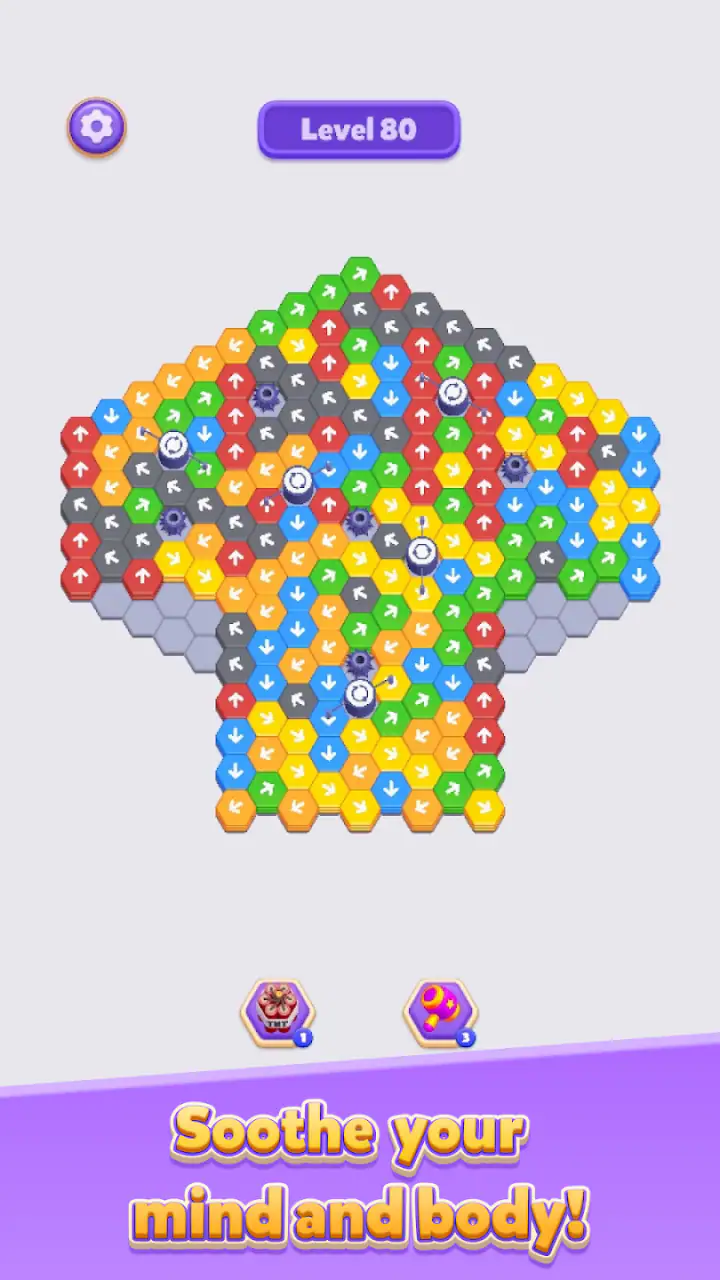
That rhythm is more important than any single move. A puzzle like this can become frustrating if the screen changes without making the consequences obvious. Here, the relationship between placement and available space remains easy to follow. I can see when I have improved the position, and I can also recognize when I have created a problem for myself.
One useful approach is to treat an empty area as a resource rather than as unfinished business. My instinct was sometimes to fill the largest open region immediately, but that could remove the flexibility needed for a later piece. Leaving a carefully chosen gap can be smarter than creating a board that looks tidy. This is one of the less obvious lessons the game teaches through play rather than explanation.
Another practical tip is to inspect the edges before committing to the center. Central placements can feel productive because they occupy visible space, yet edge areas may be more restrictive. If I dealt with those awkward zones early, later moves usually became easier to judge. This approach will not rescue every board, but it reduces the number of situations where one inconvenient pocket controls the entire round.
The feedback also supports short sessions because I do not need a long uninterrupted run to feel progress. A few thoughtful placements can be enough to create a small success, and that success often becomes the reason I continue. I might begin with the intention of playing while waiting for an appointment, then stay for another round because the previous board ended just as a better arrangement seemed possible.
There is a calm quality to this loop. It is not the kind of casual game that depends on rapid tapping or constant visual noise. I can play at my own pace, reconsider a placement, and focus on the shape in front of me. For someone who wants a puzzle to occupy attention without demanding a large time commitment, that is a meaningful strength.
Why clearing the board provides the reward
The reward in Hexascapes is mainly structural and mental. When blocks clear, the board becomes readable again. I get more room, more choices, and a fresh chance to turn a difficult position around. That change in the board is more motivating to me than a decorative reward would have been because it directly improves the next decision.
A good clear creates a compact feeling of relief. I may have spent several moves protecting a space or arranging pieces into a workable pattern, and then one placement releases the pressure. The payoff is visible immediately: clutter disappears, the remaining shapes stand out, and the puzzle feels possible again. That is the moment that gives the game its natural “one more try” pull.
I also liked that the reward is not limited to perfect play. A move can be useful even if it does not produce the biggest possible clear. Sometimes the right choice is simply the one that keeps several future options open. This makes the game less punishing for casual players who are still learning how the hexagonal board behaves.
For a more deliberate style, I recommend judging a move by three questions. Does it create a clear soon, does it preserve room for irregular pieces, and does it avoid trapping a small isolated area? I did not need to calculate every possibility, but these questions helped me replace random placement with a repeatable method. They also made losses feel more informative because I could identify which kind of space I had neglected.
The game is free, which removes the biggest barrier to trying it casually. Its Everyone content rating also makes the presentation suitable for a broad audience. I would still describe the experience as best suited to people who enjoy quiet concentration rather than players looking for a competitive multiplayer event, a narrative campaign, or a deep strategic system.
Its reception suggests that the basic loop is connecting with a sizeable audience: the game has a 4.9 average from around 6,100 ratings and has passed 100,000 installs. Those figures do not replace personal taste, but they fit my impression that the concept is immediately approachable. The short written review count is around 160, so I would treat the numerical rating as a broad signal of satisfaction rather than a detailed explanation of every player’s experience.
Resetting the board is what makes another session tempting
The reset is not merely an ending; it is the bridge to the next attempt. Once a board becomes too restricted, starting again removes the accumulated mistakes and gives me a clean space to apply what I just learned. I often returned because I could name the problem in the previous round: I filled a flexible area too soon, ignored an edge, or kept a tempting gap that became impossible to use.
That learning loop keeps the game from feeling like a series of unrelated boards. Each failed attempt gives me a small adjustment to test. I might decide to prioritize difficult spaces earlier, or I might become more patient about clearing immediately. The next session then has a purpose, even if the game itself remains simple.
This is especially useful in everyday situations where I do not want to begin a large game that demands commitment. I can open it during a short break, make a few placements, and stop when I need to return to something else. If I have more time, the same design supports a longer stretch because the next board begins without requiring a complicated setup.
At the same time, the reset can feel repetitive for players who need constant novelty. The core pleasure comes from arranging and clearing hex blocks, so anyone expecting new mechanics, a changing story, or a large progression system may find the loop narrow. I would not choose this as my main game if I wanted a long-term adventure or a puzzle collection with many distinct rule sets.
There is also a trade-off between relaxation and urgency. The game works well when I want to think quietly, but it may not satisfy someone who enjoys countdowns, fast reactions, or direct competition. Traditional match-three games can be a better alternative for players who prefer chain reactions and more immediate visual excitement. A standard square-block puzzle may suit someone who wants familiar geometry and a more established set of tactics. Hexascapes is the better fit when the hexagonal layout itself sounds like a welcome variation.
On device compatibility, the game supports Android 6.0 and later, so it is not restricted to only recent phones. The current version is 1.5.1, and the game was released on April 2, 2026. Those details make it easier to judge whether it fits a particular device, especially for someone using an older Android phone rather than a new flagship.
Who will enjoy it, and who should look elsewhere
I would recommend Hexascapes to someone who likes tactile, low-pressure puzzles and wants a game that can be understood without a long learning curve. It is a good choice for a commute, a waiting room, or a quiet evening when I want something more engaging than scrolling but less demanding than an action game. The hexagonal board adds enough difference to make familiar block placement feel worth revisiting.
It is also a sensible option for players who enjoy improving through small decisions. The game does not need elaborate planning to start, but careful players can develop habits that produce better boards. Watching an open area become useful, clearing a difficult cluster, and then using the newly available space gives the experience a satisfying sense of cause and effect.
I would suggest skipping it if your priority is a strong narrative, animated characters, online competition, or a large variety of modes. The appeal is concentrated in the central puzzle loop. That focus is a virtue when I want clarity, but it becomes a limitation if I need frequent surprises or a feeling of constant progression.
Players who are easily frustrated by boards that become difficult may also prefer a more forgiving puzzle with frequent power-ups or explicit assistance. Hexascapes asks me to learn from my own placements. Its challenge is not overwhelming at the start, but the board can become restrictive when I make several short-term choices without considering the remaining space.
My verdict on the action-to-reset loop
After spending time with it, I see Hexascapes as a focused casual game whose appeal comes from a clean sequence: place a hex block, read the board’s response, clear space, and restart with a slightly better idea. The action is simple, the feedback is easy to understand, and the reward changes the puzzle rather than distracting from it. That makes the next session feel earned instead of forced.
My favorite part is the small strategic tension between clearing now and preserving options later. A quick clear can be satisfying, but a patient placement may create the stronger board. That choice gives the game more depth than its uncomplicated presentation first suggests. The most useful habit I developed was to protect flexible spaces and treat awkward edges as problems to solve early.
EASY PLAY GAME TECHNOLOGY LIMITED has kept the experience centered on the board, which is exactly right for this type of game. I would not call it an all-purpose mobile game, and I would not recommend it to someone searching for a broad content-heavy experience. But for a free, Everyone-rated casual puzzle that fits naturally into short breaks, it is an easy one for me to recommend.
My final recommendation is simple: try it if you want a calm hex-based puzzle where every placement changes the next decision. The reason I return is not a complicated reward system. It is the possibility that one better move will open the board, turn a cramped position into a workable one, and make a fresh session feel worthwhile.
FAQs for Hexascapes - Block Puzzle
What is Hexascapes - Block Puzzle, and how do you play it?
Hexascapes - Block Puzzle is a relaxing puzzle game based on fitting hexagonal pieces onto a board. After selecting a group of blocks, you place them into empty spaces to complete lines or shapes and clear them. The objective is to make smart combinations, avoid filling the board, and achieve the highest score possible. Its simple drag-and-place controls make it easy to understand, although later puzzles require careful planning.
Is Hexascapes - Block Puzzle suitable for beginners?
Yes, Hexascapes - Block Puzzle is accessible to beginners because it does not require complicated rules, fast reactions, or previous puzzle experience. The early stages provide a gentle introduction to the hexagonal board and block placement system. However, the challenge gradually increases as available spaces become limited. Players who enjoy slower, thoughtful gameplay should find it approachable, while experienced puzzle fans may appreciate the strategic difficulty of advanced levels.
Can Hexascapes - Block Puzzle be played offline?
Hexascapes - Block Puzzle is generally designed as a casual game that can be enjoyed without a constant internet connection, which makes it convenient for travel, commuting, or short breaks. Some features may still depend on connectivity, including advertisements, optional rewards, updates, or other online services. Availability can vary by device version, so it is worth testing the game once after installation before relying on it for completely offline play.
Does Hexascapes - Block Puzzle contain advertisements or in-app purchases?
Like many free-to-download mobile puzzle games, Hexascapes - Block Puzzle may include advertisements and optional in-app purchases. Ads can appear between levels or after certain actions, while purchases may provide benefits such as removing advertising or obtaining additional assistance. The core puzzle experience is intended to be playable without spending money, but users should review the store listing and payment settings on their device before downloading, especially if children may use the app.
Is Hexascapes - Block Puzzle safe and worth downloading?
Hexascapes - Block Puzzle is a suitable choice for players looking for a lightweight, relaxing brain-training game with straightforward mechanics and short sessions. Before installing, download it only from the official Google Play Store or Apple App Store and check the listed developer, permissions, ratings, and recent reviews. The game is worth trying if you enjoy spatial puzzles, but users who dislike repetitive level-based gameplay or frequent advertising should review those details first.
Pros
- Simple drag-and-drop controls are easy to learn.
- Relaxing gameplay works well for short sessions.
- Colorful hexagonal pieces make the board easy to read.
- Offline play is convenient when no internet is available.
- Gradually harder puzzles provide a satisfying challenge.
Cons
- Limited gameplay variety may feel repetitive over time.
- Some levels can depend heavily on getting useful piece shapes.
- Ads may interrupt the experience between puzzles.
- The minimalist presentation offers little narrative or progression.
- Players seeking fast action may find the pace too slow.


